
How long is 20,000 hours, you ask? Well, buckle up as we dive into unraveling the fascinating dimensions of time. At first glance, 20,000 hours might seem like a mere number on the clock, but its implications are far-reaching. It’s not just a measure of time; it’s a journey waiting to be explored. Join us as we break down the significance of 20,000 hours and discover the hidden treasures within this seemingly ordinary unit of time. Let’s embark on this captivating adventure together.

How Long is 20,000 Hours: Exploring the Concept of Time
Welcome to our journey into the world of time, where we will delve into the fascinating question of how long 20,000 hours really is. Time is a concept that surrounds us every day, from the ticking of the clock to the changing of the seasons. But have you ever stopped to think about just how long 20,000 hours actually is?
Understanding the Basics of Time
Before we dive into the specifics of 20,000 hours, let’s take a moment to understand the basics of time. Time is a measurement of the duration between two events, marking the interval in which things happen. We use time to organize our lives, from scheduling our day to keeping track of important events.
There are different units of time that we use to measure durations, such as seconds, minutes, hours, days, weeks, months, and years. Each unit represents a different increment of time, with hours falling between minutes and days in the hierarchy of time measurement.
Breaking Down 20,000 Hours
Now, let’s focus on 20,000 hours specifically. To put it into perspective, 20,000 hours is equivalent to:
Days
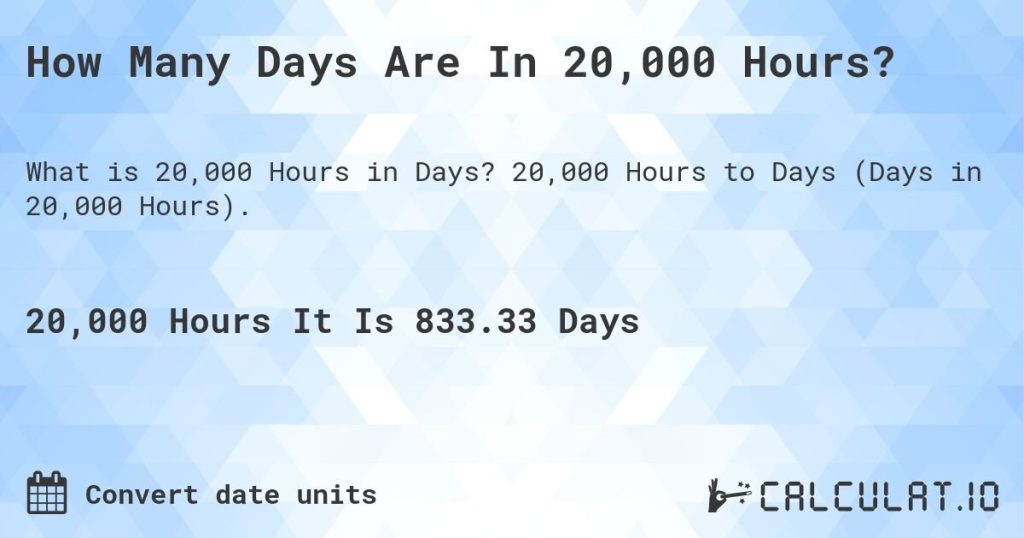
If we convert 20,000 hours into days, we would get approximately 833 days. This means that 20,000 hours is equivalent to over two years of continuous time passing.
Weeks
When we look at 20,000 hours in terms of weeks, it equals around 119 weeks. That’s almost two and a half years’ worth of hours adding up!
Months
Looking at 20,000 hours in months, it translates to roughly 277 months. This amounts to over 23 years of time passing by.
Years
And finally, in years, 20,000 hours is equivalent to approximately 833 days, which is around 55 years of time passing! Imagine spending over five decades just counting the hours.
Putting 20,000 Hours into Context
Now that we’ve broken down the numbers, let’s put 20,000 hours into context to better understand its significance in different scenarios:
Professional Development
For someone looking to master a skill or become an expert in a particular field, dedicating 20,000 hours to practice and learning can lead to mastery. This is in line with the concept of the “10,000-Hour Rule” popularized by Malcolm Gladwell, suggesting that it takes approximately 10,000 hours of deliberate practice to become an expert in any field.
Travel
For a traveler exploring the world, 20,000 hours can take them on numerous adventures, allowing them to experience different cultures, cuisines, and landscapes. From trekking through the Amazon rainforest to marveling at the ancient wonders of Egypt, 20,000 hours of travel offer endless possibilities.
Lifespan
In the context of a human lifespan, 20,000 hours may seem like a significant amount of time, but when compared to the average life expectancy of around 70-80 years, it represents just a fraction of one’s existence. It highlights the importance of making the most of our time and cherishing each moment.
So, how long is 20,000 hours? It’s not just a number; it’s a measurement of time that can have different meanings and implications depending on how it is used. Whether you’re focusing on personal growth, embarking on adventures, or simply savoring life’s moments, 20,000 hours is a reminder of the preciousness of time.
As we navigate the complexities of time, let’s remember to make the most of every hour, minute, and second, cherishing each moment as it passes by.
Time is a gift, so let’s use our 20,000 hours wisely!
20 Hour Countdown Timer
Frequently Asked Questions
How long is 20,000 hours?
20,000 hours is equivalent to approximately 833 days, or about 2.28 years when considering a standard 24-hour day.
What units of time can be used to express 20,000 hours?
20,000 hours can be converted to days, years, or even months for better perspective on the duration.
Is 20,000 hours a common reference point for measuring time?
While 20,000 hours is not commonly used in everyday conversation, it is often used in professional fields like project management or scientific research to denote a substantial amount of time.
Final Thoughts
With dedication and consistency, 20,000 hours amount to a significant investment of time – equivalent to nearly 833 days or over 2 years. This time span offers ample opportunities for growth and mastery in any skill or endeavor. Contemplating ‘how long is 20,000 hours’ emphasizes the importance of deliberate practice and persistence in achieving excellence. Ultimately, this cumulative time commitment can lead to profound expertise and accomplishment in various fields.